A chicken coop can look strong and well-built but still have several weak points that allow predators to reach the flock. A simple hook on a door, a gap beneath the run, or loosely attached fencing may be enough for a raccoon, fox, or other wildlife to get inside.
Predator protection is not just about choosing a strong fence. It requires a complete design that considers the animals in the surrounding area, their behavior, the strength of the enclosure, and the way chickens enter and leave the shelter.
A well-designed predator-resistant coop should address at least five areas: the wire enclosure, ground-level protection, roof coverage, door security, and nighttime management. This guide explains how to build or evaluate each part, with particular attention to raccoons, foxes, and suitable wire mesh materials.
Quick Answer
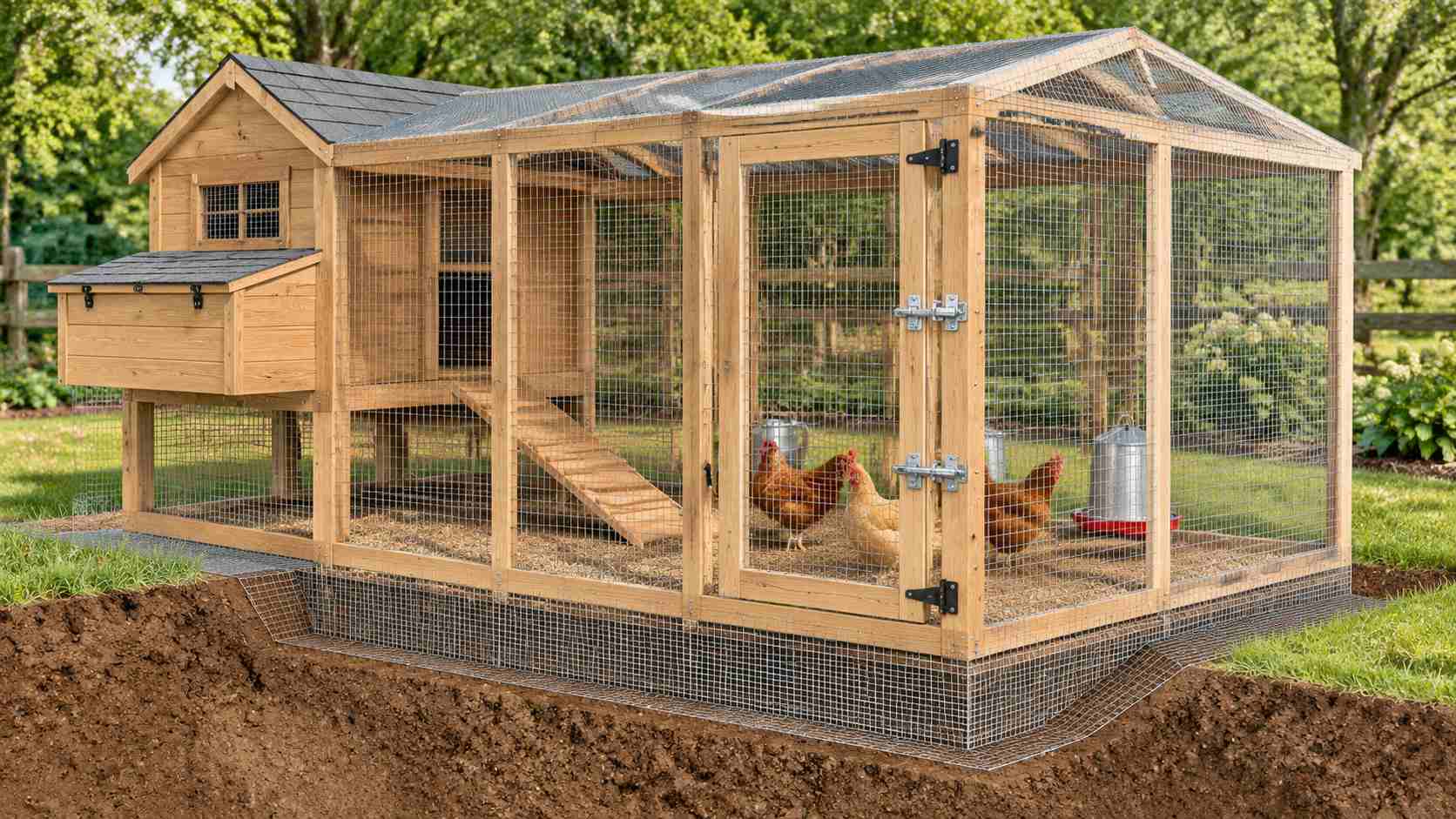
To design a predator-resistant chicken coop, use strong welded hardware cloth with approximately 1/2-inch openings for vulnerable walls, vents, and run sections. Secure the mesh with suitable screws and washers, install a buried or outward-facing anti-dig apron, cover the run roof, and use two-action locks on all access doors.
Raccoons require particular attention because they can manipulate simple latches and reach through larger mesh openings. Foxes are more likely to exploit weak ground-level fencing or dig beneath an enclosure. A complete protection system must address both types of attack rather than relying on a single material or feature.
Key Takeaways
- Use welded hardware cloth instead of relying on ordinary chicken wire for predator barriers.
- A 1/2-inch mesh opening is a common starting point for protecting coop openings and runs.
- Install an underground barrier or outward-facing mesh apron to reduce digging access.
- Use two-step or otherwise secured latches on doors, nesting-box lids, and pop doors.
- Cover the run from above to protect against aerial and climbing predators.
- Inspect corners, roof joints, ventilation openings, and floor edges because small gaps can become entry points.
- Close the coop securely every night and regularly inspect the entire enclosure.
1. Identify the Predators Before Designing the Coop
Different predators attack chicken coops in different ways. Understanding the local risks helps determine which structural features deserve the most attention.
| Predator | Common Entry Method | Main Design Response |
|---|---|---|
| Raccoons | Manipulating simple latches, reaching through large openings, climbing structures | Small mesh openings, secure fasteners, two-step locks, covered run |
| Foxes | Digging beneath fences or exploiting weak lower sections | Buried wire barriers, ground aprons, reinforced perimeter |
| Coyotes and stray dogs | Pushing, digging, or breaking weak fencing | Strong frame, reinforced mesh, secure ground connections |
| Hawks and owls | Attacking from above or entering uncovered runs | Roof mesh or a suitable solid roof |
| Weasels and mink | Passing through very small gaps and openings | Fine mesh, sealed joints, protected vents |
| Rats and snakes | Entering through floor gaps, openings, or feed-storage areas | Fine mesh, protected floors, sealed openings, proper feed storage |
The most effective design begins with a local predator assessment. A property with frequent fox activity may need more attention to underground barriers, while an area with raccoons requires particularly secure latches and smaller mesh openings.
2. Choose the Right Wire Mesh for the Coop and Run
Wire mesh is one of the most important components of an outdoor chicken enclosure. It must keep chickens inside while preventing predators from reaching through, pulling apart, or passing through the barrier.
Why Ordinary Chicken Wire Is Not Enough
Traditional chicken wire is mainly designed to contain poultry. Its twisted construction and relatively large openings do not provide the same protection as welded metal mesh.
A raccoon may reach through an opening and grab a chicken even without entering the enclosure. Larger animals can also damage weak fencing. For this reason, chicken wire should not be treated as the primary security barrier where mammalian predators are present.
It may still be useful for certain secondary containment applications, but a predator-resistant enclosure needs a stronger material.
When to Use Hardware Cloth
Hardware cloth is a welded wire mesh with a grid pattern. Galvanized versions are commonly used in outdoor enclosures because the protective zinc coating helps resist corrosion.
For many backyard applications, 1/2-inch openings are a practical starting point for run walls, vents, and vulnerable openings. Where smaller predators such as weasels are a concern, 1/4-inch mesh may be more appropriate for selected openings.
Mesh size is not the only specification that matters. Wire diameter, gauge, weld quality, corrosion protection, and attachment method all influence the finished barrier's strength.
| Mesh Type | Characteristics | Typical Consideration |
|---|---|---|
| Ordinary chicken wire | Twisted wire with relatively large openings | Suitable for basic poultry containment, not a reliable primary predator barrier |
| 1/2-inch welded hardware cloth | Small welded openings and a more rigid grid structure | Common choice for raccoon-resistant enclosure sections |
| 1/4-inch hardware cloth | Finer openings for smaller animals | Useful for vulnerable vents and areas with weasel or mink risks |
| Larger welded wire mesh | Stronger structural fencing with larger openings | May need an additional fine-mesh layer to prevent reaching through |
The selected mesh should be attached to a solid frame rather than simply stretched over the structure. Use suitable exterior-grade screws and large washers or other engineered fasteners. This helps distribute pulling forces and reduces the risk of the mesh being detached from the frame.
3. How to Make a Chicken Coop Raccoon Proof
Raccoons are particularly challenging because they combine climbing ability, strong paws, and the ability to manipulate simple mechanisms. A coop may have a strong wooden frame and still be vulnerable if the door uses an easy-to-open hook or sliding bolt.
Install Two-Step Door Locks
A basic hook-and-eye latch or a simple sliding bolt should not be the only security measure. Use a locking arrangement that requires two separate actions, such as lifting and sliding, or add a carabiner or locking clip to a suitable latch.
Apply the same principle to every opening that can provide access to the birds:
- Main entrance doors.
- Chicken pop doors.
- Nesting-box access lids.
- Cleaning doors and maintenance panels.
- Any removable access cover.
Prevent Reaching Through the Mesh
A raccoon does not always need to open the door to reach a chicken. If the run uses large openings, an animal may be able to insert its paw through the fence.
Use small-opening welded mesh around the lower walls and other areas accessible to predators. Check that the distance between the mesh and the frame does not create an additional opening.
Strengthen the Roof and Climbing Access Points
Raccoons can climb wooden frames, fence posts, and nearby structures. A run with strong side walls but an open top may still be vulnerable.
Install a secure roof barrier or suitable overhead mesh, and inspect the points where the roof meets the side walls. Nearby tree branches, sheds, and low structures should also be considered when positioning the enclosure.
4. How to Make a Chicken Coop Fox Proof
Foxes are capable diggers. A fence that is strong above ground may still fail if it ends directly at the soil surface. The most important design consideration is the connection between the enclosure and the ground.
Install a Buried Wire Barrier
One method is to extend galvanized welded mesh below ground around the perimeter of the run. A buried barrier approximately 12 inches deep is a commonly recommended starting point, although soil conditions and local predator behavior may require additional protection.
The mesh should be securely connected to the above-ground fencing so that there is no gap between the two sections.
Use an Outward-Facing L-Shaped Apron
A practical alternative is to attach hardware cloth to the bottom of the run wall and extend it horizontally outward across the ground. This is often called a predator apron or anti-dig apron.
A typical design uses an outward extension of approximately 12–24 inches. The mesh can be covered with soil, gravel, or turf and secured with appropriate ground pins.
The idea is simple: a fox approaching the fence and digging at its base encounters the horizontal mesh rather than finding an open route beneath the wall.
Both approaches have advantages. A buried barrier can provide a neat finish but requires excavation. An outward apron is often easier to install around an existing run, although it needs adequate ground coverage and secure fastening.
Protect the Floor and Lower Frame
A raised wooden coop should have a properly enclosed floor. If predators can access the underside, an exposed or weak floor can become another vulnerable point.
Check the connection between the floor, side panels, and run. The lower frame should be firmly secured, and any opening around the base should be closed with suitable materials.
5. Design the Roof to Prevent Aerial and Climbing Attacks
The top of a chicken run is sometimes overlooked because most fencing projects focus on the walls. However, hawks and owls can attack from above, while climbing animals may enter through an uncovered enclosure.
There are two common approaches to run roof design:
Welded Mesh Roof
A properly supported mesh roof creates a physical barrier above the run. It should be securely connected to the side fencing, with no loose corners or gaps at the edges.
The supporting frame must also be strong enough to carry the mesh and withstand expected outdoor conditions. In areas with snow or heavy rainfall, structural loading should be considered during design.
Solid Weatherproof Roof
A solid roof can provide both overhead protection and shelter from rain and direct sunlight. Sloped roofing helps water drain away rather than collecting on the surface.
For larger enclosures, a combination of solid roofing and secure mesh sections can provide a balance between weather protection, airflow, and visibility.
The roof should never compromise ventilation. Enclosed sleeping areas still need sufficient airflow, and any ventilation openings must be protected against predator access.
6. Strengthen Doors, Windows, and Ventilation Openings
A predator-resistant design is only as strong as its weakest opening. Even when the main walls are properly reinforced, small gaps around windows, roof edges, and access panels can create an entry point.
During design and assembly, pay particular attention to these areas:
- Windows: Install secure mesh behind openings and ensure that frames cannot be pushed loose.
- Ventilation openings: Cover vents with suitable welded mesh while maintaining sufficient airflow.
- Roof joints: Check for spaces between the roof, walls, and support beams.
- Access panels: Use secure hinges and locking mechanisms that cannot be easily lifted or pushed open.
- Run connections: Reinforce the point where the wooden coop connects to the mesh enclosure.
- Floor edges: Close gaps between the floor and lower frame.
A useful inspection method is to walk around the coop with a flashlight and check every joint from both inside and outside. Look for openings, loose screws, damaged mesh, and areas where the frame has separated.
7. Material Selection: Wood, Metal Mesh, and Protective Hardware
A durable chicken coop depends on how the materials work together. The wooden frame supports the enclosure, the mesh creates the physical barrier, and the hardware keeps the individual components connected.
| Component | Recommended Design Consideration | Potential Weakness to Check |
|---|---|---|
| Wooden frame | Strong structural members and securely connected joints | Loose connections, rot, cracks, or damaged lower sections |
| Wire mesh | Appropriate welded mesh with suitable opening size and corrosion protection | Large openings, weak welds, rust, or loose attachment |
| Hinges and screws | Outdoor-suitable corrosion-resistant hardware | Rust, exposed fasteners, or weak fixing points |
| Door locks | Two-step locking or an additional security clip | Simple hooks and easily manipulated sliding bolts |
| Roof | Securely connected mesh or weatherproof roofing with suitable support | Loose corners, unsupported sections, and open access points |
Chinese fir is commonly used in wooden outdoor chicken coop manufacturing because it is relatively lightweight and easy to process. However, wood selection alone does not guarantee long-term outdoor durability. Surface treatment, drainage, roof protection, joint construction, and maintenance all influence service life.
8. Practical Product Examples: Predator-Resistant Coop Structures
Different flock sizes and outdoor layouts require different structural arrangements. Several existing Shaw Ye products illustrate how wooden shelters, enclosed runs, mesh sections, and access features can be combined.
CC005: Large Wooden Chicken Coop with Wire Run
The CC005 is a large wooden chicken coop measuring 265 × 247 × 194 cm. Its published design includes a wooden frame, mesh-fenced run, nesting area, sloped roof, and multiple access points. The product is listed for 10–20 chickens.
For larger backyard flocks, this type of structure provides an example of combining a protected sleeping area with a dedicated activity enclosure. Buyers should confirm the mesh specification, fastening method, and ground protection details when predator resistance is a priority.
View CC005 product specifications
CC072: Multi-Level Coop with Reinforced Wire Mesh
The CC072 measures 202 × 78 × 145 cm and is listed for 10–15 chickens. Its product description identifies reinforced galvanized wire mesh, a weather-resistant roof, a nesting compartment, and a removable cleaning tray.
The combination of a wooden shelter and mesh enclosure provides a useful reference for brands developing outdoor poultry housing. The actual mesh opening size, wire gauge, attachment details, and any underground barrier should still be confirmed against the intended predator risks.
View CC072 product specifications
CC301: Full Mesh Run Structure
The CC301 measures 168.5 × 66 × 115.5 cm and features a full mesh run structure, a wooden shelter, a sloped roof, and accessible doors. It is listed for 4–6 chickens.
For compact backyard applications, a full mesh enclosure can provide visibility and outdoor movement while keeping the flock within a defined area. The roof, mesh connections, lower frame, and door locks remain important parts of the overall protection system.
View CC301 product specifications
These products demonstrate different enclosure layouts, but a product description that mentions predator-resistant mesh should not be interpreted as proof that the complete structure can withstand every local predator. Buyers should request detailed mesh and locking specifications when purchasing for high-risk locations.
9. Daily Management Is Part of Predator Protection
Even a well-built coop needs regular management. Predators often take advantage of doors left open, damaged fencing, spilled feed, or gaps that develop after months of outdoor exposure.
A simple daily and weekly inspection routine can reduce these risks:
- Close and lock the main coop door before nightfall.
- Check that all chickens are inside before securing the enclosure.
- Store feed in sealed containers to avoid attracting rodents and other wildlife.
- Remove spilled feed and food waste from the run.
- Inspect mesh, hinges, and latches for damage or corrosion.
- Look for digging marks around the perimeter.
- Trim vegetation that provides predators with convenient hiding or climbing access.
- Check the roof and ground apron after severe weather.
Automatic chicken doors can help maintain a consistent closing schedule, but they should be checked regularly. A door that fails to close or becomes obstructed can leave the entire flock exposed.
10. Predator-Resistant Chicken Coop Design Checklist
Before completing a new coop or approving a customized production sample, use the following checklist to review its main protection features.
| Inspection Area | What to Check |
|---|---|
| Main frame | Stable structure, secure joints, no damaged wood |
| Wire mesh | Suitable opening size, strong welds, secure fixing |
| Ground protection | Buried mesh or outward-facing apron with no gaps |
| Roof | Secure overhead barrier and properly connected edges |
| Door locks | Two-step locking and secure hinges |
| Ventilation | Adequate airflow with protected openings |
| Cleaning access | Removable trays and securely closing access panels |
| Routine maintenance | Regular inspection of mesh, locks, and ground barriers |
11. Frequently Asked Questions
What is the best wire mesh for a predator-resistant chicken coop?
Welded galvanized hardware cloth with approximately 1/2-inch openings is a common choice for many backyard chicken coops. It provides smaller openings than ordinary chicken wire and offers a more rigid structure. Smaller mesh may be needed in areas with weasels or other small predators.
Can raccoons get through chicken wire?
Raccoons can exploit large openings by reaching through the wire, and they may damage weak fencing or manipulate simple latches. Chicken wire should not be relied upon as the main predator barrier. Use properly secured welded mesh and reinforced door locks instead.
How deep should wire mesh be buried to stop foxes?
A buried barrier around 12 inches deep is a commonly used starting point. Another option is to extend a mesh apron approximately 12–24 inches outward along the ground. The appropriate design depends on soil conditions and the local predator risk.
Can a fox climb into a chicken coop?
Foxes are capable climbers and jumpers, so a fence that only protects the lower perimeter may not be sufficient. The enclosure should have adequate height, secure connections, and suitable overhead protection where necessary.
Do I need a roof over the chicken run?
An overhead barrier helps protect chickens from hawks and owls and can prevent climbing predators from entering from above. A suitable mesh roof or solid roof can be used depending on the climate and structural requirements.
Are wooden chicken coops safe from predators?
Wooden coops can provide a strong shelter when they use sound structural joints, protected openings, secure doors, and reinforced mesh sections. The material alone does not determine predator resistance. The complete design and quality of assembly are more important.
What makes a chicken coop raccoon proof?
A raccoon-resistant design uses small-opening welded mesh, securely attached fencing, two-step door locks, protected roof connections, and a reliable nighttime closing routine. No single feature guarantees complete protection.
How often should I inspect a predator-resistant chicken coop?
Check doors and locks every day, and inspect the mesh, frame, roof, and ground perimeter regularly. A more thorough inspection should also be performed after strong winds, heavy rain, or any suspected predator attempt.
For wholesale buyers and distributors, predator-resistant design is an important factor when evaluating outdoor chicken coop products. Shaw Ye, operated by Fuzhou Shaw Ye Arts & Crafts Co., Ltd., has manufactured wooden pet houses and chicken coops since 1998, with OEM and ODM customization capabilities.
When developing a new product, buyers can discuss mesh specifications, door structures, run configurations, roof designs, and customized dimensions with the manufacturer. These details should be included in the product specification and checked on production samples before bulk orders.
Explore the wooden chicken coop collection to compare different outdoor enclosure structures and design options.