Across North America, PTACs take care of heating and cooling in countless hotel rooms and apartments. But those factory knobs and dials haven't changed in decades. Bending down over the carpet to twist a control knob just makes life harder for both guests and property managers.
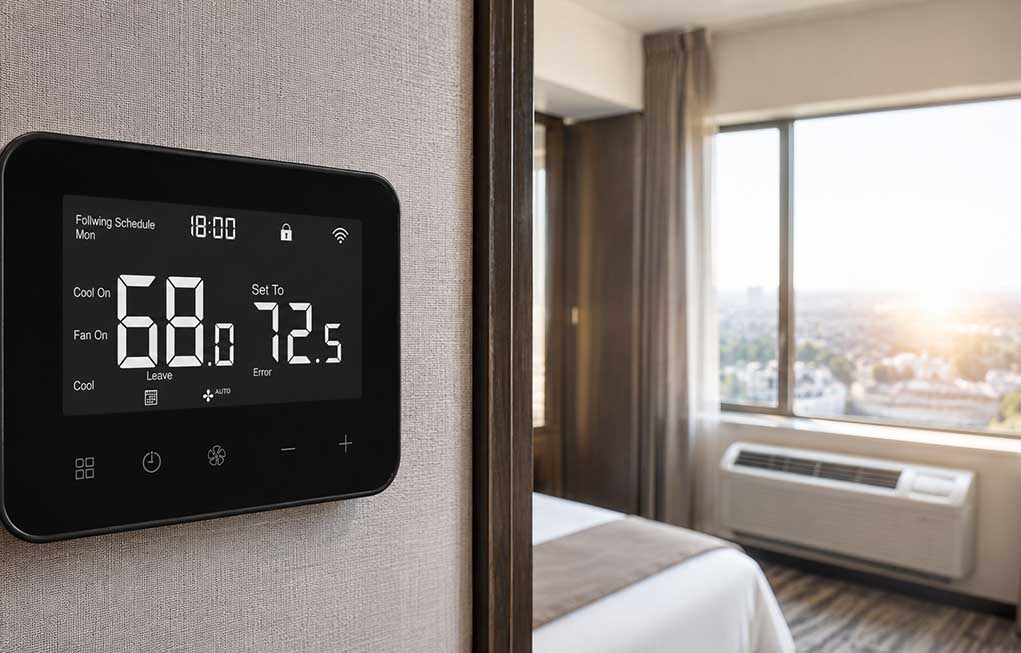
That is why so many sites are ditching built-in controls for wall units. Looking at the wider picture of HVAC thermostat applications, taking on a wireless PTAC thermostat retrofit solves three problems at once: you stop guests from freezing empty rooms, let front-desk staff control temps from their desk, and never have to patch up a wall.
1. Stop Paying to Cool Empty Rooms
Most hotel rooms sit empty for at least 12 hours every day. If you don't run tight hotel PTAC energy management, guests will crank the AC to 16°C (60°F), grab their bags, and head out for the whole day. The compressor runs non-stop, cooling an empty room at your expense.
Digital thermostats stop this right at the hardware. You can lock in minimum cooling and maximum heating limits inside the setup menu. Add in vacant setback profiles, and the unit automatically steps down when rooms are empty. That usually takes 20% to 30% right off your room electric bill.
2. Desk-Level Control for Hotel Teams
Nobody wants maintenance staff running up and down corridors just to shut off units after check-out. Tying these controllers into IoT setups like Tuya changes the daily routine completely.
Front desk staff can glance at a tablet to see every room on site. They can park empty suites in eco-mode, or warm up a room ten minutes before a guest walks in the door. It makes hospitality HVAC control simple, quick, and centralized.
3. The Two-Piece Setup: No Drywall Repairs
Pulling new thermostat wire through finished walls is messy, loud, and takes rooms out of inventory. The lost room revenue alone often kills the project budget.
Going wireless gets around this entirely by splitting the system into two parts:
- The Control Receiver: A small module that wires straight into the PTAC terminal block and hides neatly under the front cover.
- The Wall Display: A clean battery-powered screen you can stick on any drywall surface. It talks to the base box over sub-GHz radio without a single wire in the wall.
Make the Switch with E-TOP Controls
Upgrading older PTAC units shouldn't mean taking rooms offline for days. Our Wireless WIFI Smart Thermostat and Module for PTAC gives you accurate room temp sensing, easy app controls, and an install time measured in minutes.
Looking to Upgrade Your Property?
Get in touch with our team to talk through volume pricing, custom branding options, or wiring specifics for your upcoming job.
View Product Specifications ➔Frequently Asked Questions (FAQ)
+ Q1: How much energy can we actually save with smart PTAC controls?
A: Most properties see power bills fall by 20% to 30%. You get the biggest drop by setting hard temp limits and letting empty rooms dial back instead of running wide open all day.
+ Q2: What does a decoupled thermostat system mean?
A: It means the wall screen and the switching board are separated. A tiny box goes inside the PTAC to run the relays, while the battery screen hangs on the wall and talks to it through wireless RF. No conduit cutting needed.
+ Q3: Can front desk staff manage PTAC units from a computer or tablet?
A: Yes. As long as you pick Wi-Fi or gateway models, your team can pull up a central tablet or dashboard, check room readings, and push setpoint adjustments without knocking on guest doors.
+ Q4: Do I need an electrician to mount the wireless wall display?
A: No electrician needed for the wall screen. It runs on regular batteries and mounts with simple screws. You only need basic maintenance tools to wire the small receiver module into the PTAC's terminal strip.