{ 868MHz wireless boiler thermostat }

  • Salus or Honeywell Wireless Thermostat Alternatives for European Wholesalers

    For HVAC wholesalers and plumbing merchants across Europe, stocking the right wireless boiler thermostats is always a balancing act. Honeywell Home and Salus Controls have long been the go-to choices — but rising costs and shrinking margins are pushing many distributors to look for smarter alternatives.

    If you want a reliable, high-margin, trade-only option that matches the performance of the big names, the E-TOP WT-02 Programmable Wireless Room Thermostat is gaining strong traction among B2B players.
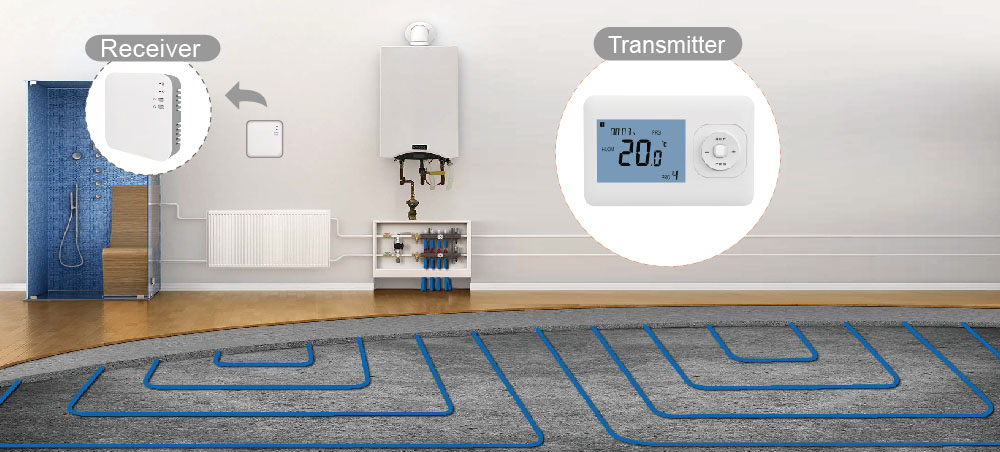
    E-TOP WT-02 wireless boiler thermostat wiring diagram in European utility room, a direct alternative to Honeywell T3R and SALUS RT510RF for B2B wholesale

    1. 868MHz RF Reliability – Same Standard as Salus & Honeywell

    Installers trust Salus (e.g. RT510RF) and Honeywell (e.g. T3R, DT4R) mainly for their stable wireless performance. Most experienced engineers avoid standard Wi-Fi thermostats in European homes with thick brick walls and solid floors.

    The E-TOP WT-02 uses the exact same 868MHz RF frequency to ensure:

    Extended Range: Open line-of-sight range up to 300 meters.

    Superior Penetration: Strong wall and floor penetration for multi-story buildings.

    Fully Offline Operation: The link between transmitter and receiver stays active even if the home internet drops out.

    This dramatically reduces callback complaints and costly after-sales visits for your trade customers.

    2. True Universal Compatibility

    Wholesalers hate managing too many individual SKUs. To simplify your inventory, the WT-02 receiver features a heavy-duty 3A volt-free (dry contact) relay.

    This single unit makes it universally compatible with the vast majority of European boilers on the market, including Vaillant, Bosch, Baxi, Worcester, Viessmann, and more. For higher-efficiency commercial projects, OpenTherm modulation protocol is also available on request for bulk orders.

     3. Commercial Advantages for Wholesalers

    Feature Honeywell / Salus E-TOP WT-02
    Primary Frequency 868MHz RF 868MHz RF
    Wholesale Margins Tight / Highly Competitive Significantly Higher
    Online Price Transparency Very High (Consumer Retail) Strictly Protected B2B Supply
    Private Label / OEM Limited / Not Available Fully Supported (Logo & Box)
    Certifications CE / UKCA TUV Rheinland CE & UKCA

    With E-TOP, you can protect your counter margins, offer competitive project pricing, and even build your own brand equity.

    4. Fully Certified for EU & UK Markets

    Sourcing an alternative should never mean compromising on regulatory peace of mind. The E-TOP WT-02 is fully project-ready:

    TUV Rheinland Certified: Full CE certification covering RED, EMC, and LVD directives.

    UKCA Compliant: Ready for hassle-free importation and distribution within the UK.

    REACH & RoHS Compliant: 100% safe material standards for European commercial bidding.

    On-Board EEPROM Memory: All installer programs and 7-day schedules survive building power cuts.


    Bottom Line

    Honeywell and Salus remain strong premium choices. However, for social housing projects, new residential developments, and independent wholesalers looking to improve profitability, the E-TOP WT-02 delivers matching 868MHz performance and compatibility at much more sustainable commercial terms.

    Ready to diversify your range? Contact our B2B team today for testing samples, volume pricing, or OEM customization details.

    Contact Us to Request an E-TOP WT-02 Sample
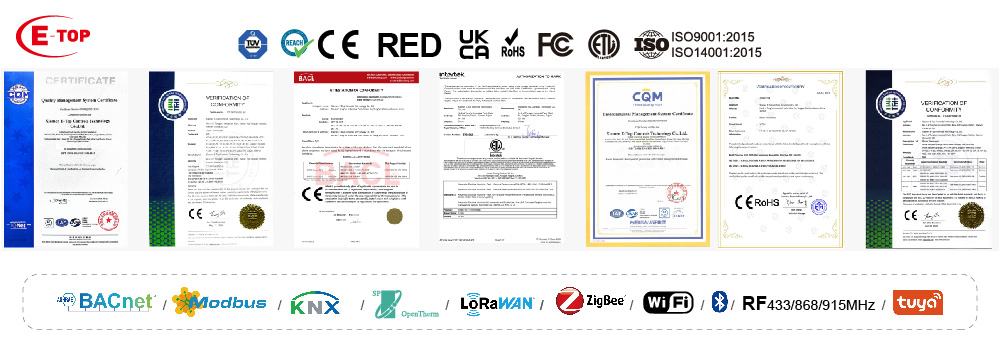
    E-TOP HVAC control factory certificates including CE, RED, UKCA, ISO and supported protocols like BACnet, Modbus, ZigBee, and OpenTherm

    ----------------------------------------------------------------------------------------------------------------------------------------------------------------------

    Frequently Asked Questions


    Q1: Can the E-TOP WT-02 replace a Honeywell T3R or Salus RT510RF without changing the boiler wiring?

    A: Yes. Since the E-TOP WT-02 receiver uses the standard 3A volt-free (dry contact) relay connection method common to European heating systems, the wiring configuration is identical to the Salus RT510RF or Honeywell T3R. Contractors can swap the units seamlessly using the existing boiler control terminals.


    Q2: How does the E-TOP WT-02 handle data retention during building power outages?

    A: The thermostat transmitter is equipped with an on-board EEPROM non-volatile memory chip. Even if batteries are removed or the building experiences a seasonal grid power cut, all installer configurations, 7-day programmable schedules, and temperature settings are automatically saved without requiring a reset.


    Q3: Do you support custom branding and logo printing for regional plumbing and heating merchants?

    A: Yes, supporting regional wholesalers and OEM partners is our core business. We provide comprehensive private label customization services, including custom logo printing on the thermostat casing, tailored user manual printing, and bespoke wholesale box packaging based on minimum B2B order volumes.
     

  • Why 868MHz is the Best Frequency for Wireless Boiler Thermostats in Europe (vs. 433MHz)

    In the European HVAC market, reliability is not optional — it is a regulatory and practical necessity. As more households adopt wireless boiler thermostats, the choice of RF frequency has become one of the most important technical decisions for manufacturers and distributors.

    At E-TOP, we provide flexible RF solutions for diverse market needs. While we offer 433MHz as a cost-effective choice for general consumer applications, we strongly recommend our 868MHz series as the performance-grade standard for the professional European HVAC market.

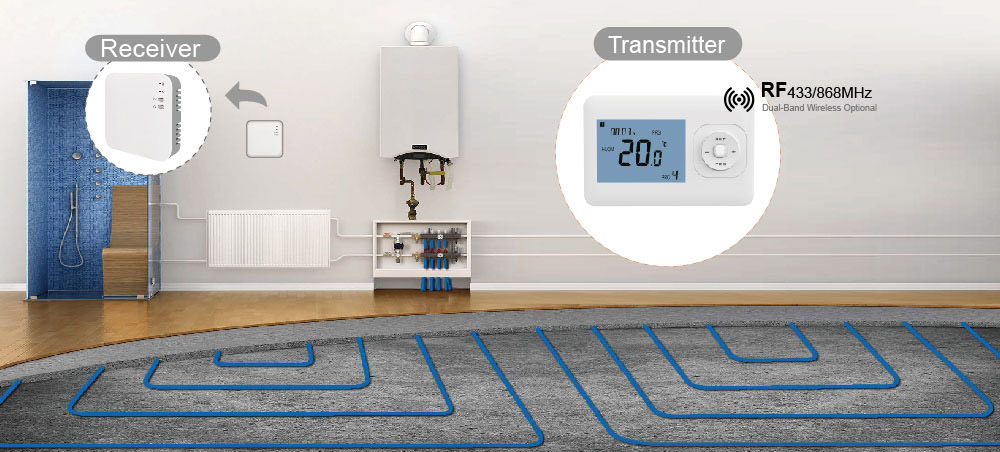
    Wireless boiler thermostat system with 868MHz and 433MHz dual-band RF options

    1. Superior Anti-Interference Performance

    The 433MHz band is heavily congested. It is shared with garage door openers, car key fobs, baby monitors, wireless doorbells, and many low-cost consumer devices. In dense European residential areas, this leads to frequent signal collisions and communication failures between the thermostat and boiler receiver.

    In contrast, the 868MHz band is strictly regulated in Europe and primarily reserved for professional SRD (Short Range Devices) applications such as security systems and HVAC controls. This dedicated environment results in significantly lower interference and much higher signal reliability.

    2. Full Compliance with European Regulations

    European standards (RED Directive and ERP Eco-design) impose a strict 1% duty cycle limit on the 868MHz band — meaning devices can only transmit for a maximum of 36 seconds per hour.

    This regulation forces manufacturers to develop smarter, more efficient communication protocols. 868MHz thermostats are therefore designed to be highly optimized, fully CE and RED compliant, and aligned with Europe’s strict energy efficiency requirements. Many 433MHz products struggle to meet these standards consistently.

    3. Better Real-World Performance in European Buildings

    Traditional European homes often feature thick brick, stone, or concrete walls. While 433MHz may show slightly longer range in open spaces, 868MHz delivers superior reliability when transmitting through multiple walls, floors, and metal piping.

    Lower packet loss and intelligent retransmission mechanisms make 868MHz the more stable choice in real residential installations — exactly what European installers and end-users demand.

    4. Longer Battery Life & Lower Maintenance Costs

    Thanks to shorter, more efficient data packets and regulated transmission, 868MHz wireless thermostats consume significantly less power. Distributors and installers frequently report 2–3 times longer battery life compared to 433MHz models, resulting in fewer service calls and higher customer satisfaction.


    Market Insights: The Role of 433MHz in Established Markets

    While 868MHz is increasingly becoming the golden standard for professional, high-performance HVAC installations across Europe, we recognize that 433MHz continues to hold a significant market presence. This is particularly true in markets with a large installed base of legacy systems—such as parts of the UK, Greece, and Southern Europe—where compatibility with existing infrastructure is a priority. Additionally, 433MHz remains a cost-effective solution for budget-constrained projects or residential settings where RF interference is minimal. At E-TOP, we offer both frequencies to ensure our partners have the technical flexibility to meet diverse regional demands.

    Conclusion & E-TOP’s Expertise

    With over 20 years of hands-on B2B OEM/ODM manufacturing expertise, E-TOP Controls builds all our European-bound wireless boiler thermostats exclusively on the 868MHz frequency band.

    Our engineering team pairs this industry-proven RF standard with proprietary pairing algorithms and TUV-certified manufacturing. The result? Fully CE/RED/RoHS compliant solutions that protect your profit margins and eliminate post-sale headaches.

    Looking for a trustworthy 868MHz wireless boiler thermostat supplier?

    Contact E-TOP today to request factory samples, detailed data sheets, and competitive B2B wholesale pricing.

    ---------------------------------------------------------------------------------------------------------------------------------------------------------------------

    FAQ (Frequently Asked Questions)


    Q1: Can an 868MHz wireless thermostat work with any European boiler brand?

    A: Yes. E-TOP's 868MHz wireless thermostats use a standard potential-free (Volt-Free) relay receiver or OpenTherm protocol, making them universally compatible with most major European combi and system boilers (such as Vaillant, Bosch, Baxi, and Ideal). The 868MHz frequency specifically handles the wireless communication stability between the room unit and the boiler receiver, regardless of the boiler brand.


    Q2: Does a thick brick or concrete wall block the 868MHz signal in old European buildings?

    A: While all wireless signals experience some attenuation when passing through solid structures, 868MHz performs significantly better than higher frequencies (like 2.4GHz Wi-Fi) and is much more reliable than 433MHz. Thanks to its longer wavelength and intelligent data packet retransmission, E-TOP’s 868MHz RF technology can easily penetrate typical multi-story residential brick and concrete walls, ensuring zero dropped commands from the living room to the basement boiler room.


    Q3: Why do 868MHz wireless thermostats save more battery than 433MHz models?

    A: European regulations restrict the 868MHz band to a 1% duty cycle, meaning devices can only transmit for a total of 36 seconds per hour. Because of this legal efficiency requirement, E-TOP designs highly optimized, ultra-short data packets that only burst when a temperature change occurs. In contrast, unrestricted 433MHz models often broadcast continuously, dragging down battery life. This design allows E-TOP 868MHz thermostats to achieve a typical battery lifespan of 2–3 years, drastically reducing maintenance costs.