{ Wall Mounted Air Conditioner Supplier }

  • Forming Challenges of Replacing Copper with Aluminum in Heat Exchangers

    Why is replacing copper with aluminum gradually a trend in the air conditioning industry?

    In 2026, the price of raw material copper has risen to about 18%, which brought enormous stress to the traditional air conditioner manufacturing regarding copper in the core position.


    Advantages in manufacturing with aluminum materials:


    Lower Raw Material Costs: Copper is significantly more expensive than aluminum. Because raw materials will have a substantial influence on the production cost of an air conditioner, changing to aluminum lets manufacturers protect profit margins. 

    Lighter weight making up for air conditioners: Aluminum weights are far less than copper. It's easier to move, handle, and install air conditioners that are lighter, and they put less stress on buildings and mounting frames. More lightweight air conditioning systems facilitate transportation, handling, and installation while exerting reduced structural strain on structures and mounting brackets.

    Resistance to Formicary Corrosion: Conventional copper piping in air conditioning systems is susceptible to early deterioration due to formicary corrosion (minute pinhole leaks triggered by organic acids and lubricants). Instead, aluminum is naturally resistant to this particular sort of corrosion.

    Innovative Engineering Technology: Modern all-aluminum microchannel heat exchangers use flat tubes with short parallel pathways rather than spherical copper pipes. These designs achieve high heat transfer efficiency while employing less material by weight.


    Difficulty in mechanical forming and processing:


    a) Lack of accurate control of size. When there is bending or stamping, make it much easier to wrinkle, flatten, or produce micro-cracks because of the poor ductility of aluminum.

    b) Cause damage to the structure. Thermal stress, the linear expansion coefficient of aluminum is large, and the thermal expansion and contraction are serious during the alternation of cold and heat, which can easily lead to structural deformation or loose joint surface.

    c) High requirements for micro-channel forming. The porous thin-walled flat tube is extremely dependent on high-precision mold and process control when it is extruded, shaped, and assembled with fins.


    Limits on the welding and connection process


    1. The welding temperature place is quite narrow: Due to the low melting point of the aluminum and the high-level surface oxide film’s melting point, it can easily lead to overburning and collapse of the base metal or cold welding during brazing.

    2. Difficult connection of dissimilar metals: Direct contact between copper and aluminum is easy to cause galvanic corrosion, which requires friction welding, flash butt welding, or special coating, and the process is complex and the defective rate is high.


    Physical and service performance defects compensate for:


    1. Inherently insufficient heat conduction efficiency: the thermal conductivity coefficient is only 60% of that of copper, which needs to be compensated by complex design such as strengthening internal teeth, optimizing fins, or increasing the windward side.

    2. Poor corrosion resistance under harsh working conditions: pitting and perforation are easy to occur in salt spray or industrial environments, so surface treatment processes such as zinc spraying or anticorrosive coating must be added.


    Cost‑saving and lightweight promote copper‑to‑aluminum replacement, while forming and reliability challenges restrict large‑scale popularization. Continuous process optimization is essential for wider industry adoption.

  • Split Air Conditioner & Concealed Duct AC Which One Matches Your Project Properly?

    The choice between a wall-mounted AC unit and a ducted AC unit mainly depends on budget, floor height, and ceiling design as well as aesthetic needs: choose a wall-mounted unit if you’re looking for value for money and easy installation; choose a ducted unit if you want a discreet appearance and overall aesthetic appeal.


    Features of Wall-Mounted Units


    Affordable: The purchase and installation costs are relatively low, and maintenance is simple.

    Doesn’t take up ceiling height: No drop ceiling is required; the unit is mounted directly on the wall, making it suitable for rooms that are already finished or where you don’t want to install a drop ceiling.

    Easy to install and remove: Cleaning, maintenance, or replacement in the future is straightforward.

    Aesthetic limitations: The unit and ductwork are visible on the wall, which inevitably affects the room’s appearance.


    Ducted Air Conditioner Features


    Superior aesthetics: It is concealed within the ceiling, and it has only the air outlet visible, which creates a cleaner, more elegant look.

    Space-saving: Does not occupy wall space or have a large footprint, freeing up floor space and activity areas.

    Improved comfort: Since the airflow comes out from 4-way / 8-way directions, it will be a lot gentler and even, showing better temperature manageability.

    Higher budget requirement: Installation is more complicated and expensive, and it must be done in conjunction with a suspended ceiling, which may have an impact on ceiling height and structure. The ceiling decoration can be changed.


    Why are there completely different equipment options for the same cooling requirements?


    Whether to choose a ducted concealed air conditioner or a split wall-mounted air conditioner essentially comes down to matching the characteristics of the different usage habits according to various demands and space structure.

    For separating cooling zones in one office, a combination of multiple ducted units is surely more energy-efficient.

    In industrial environments with explosion-proof requirements, specialized explosion-proof ducted units, or the T3 model, must be selected.


    We are a professional air conditioner manufacturer in China. Should you have any other questions in the industry, please don't hesitate to reach us!


    FAQ


    How to choose between wall-mounted split AC and concealed duct AC for my project?

    --- The selection depends on budget, ceiling height, ceiling design, and aesthetic demands. Choose wall-mounted AC for better cost performance and easy installation; pick concealed duct AC if you pursue hidden installation and overall interior beauty.


    What are the main benefits of wall-mounted split air conditioners?

    --- It features low purchasing and installation costs and simple maintenance. It requires no suspended ceiling and will not occupy ceiling height. Installation, cleaning, and future replacement are all convenient.


    What is the biggest disadvantage of wall-mounted AC units?

    --- The indoor unit and connecting pipes are exposed on the wall, which will affect the overall interior aesthetic effect.


    What core advantages does a concealed duct air conditioner have?

    --- The unit is hidden inside the ceiling with only air outlets visible for elegant decoration. It saves wall space. Besides, airflow is softer and temperature distribution is more uniform to achieve higher comfort.


    What should I notice if I plan to install concealed duct AC?

    --- It requires higher investment and complicated installation. A suspended ceiling is mandatory, which will occupy part of the ceiling height and brings certain restrictions to ceiling structure and decoration.

  • The Higher The Seasonal Energy Efficiency Ratio (Seer), The Better The Air Conditioner It Will Be?

    When choosing air conditioners, many customers will see a label with a SEER value. While the salesman would stress that the higher the SEER, the more energy-saving the air conditioner will be. But is the higher SEER a better option? Now we are showing you the facts behind it and helping you select the air conditioner more scientifically.


    I. What is SEER?


    SEER, fully named Seasonal Energy Efficiency Ratio, is used to measure the average energy efficiency level of an air conditioner in one cooling season.

           Calculation formula:

    SEER = Total annual cooling capacity (BTU) ÷ Total annual electricity consumption (Wh).


    The higher the SEER value, the better the cooling effect of the air conditioner in the unit power consumption and the better the energy-saving performance.
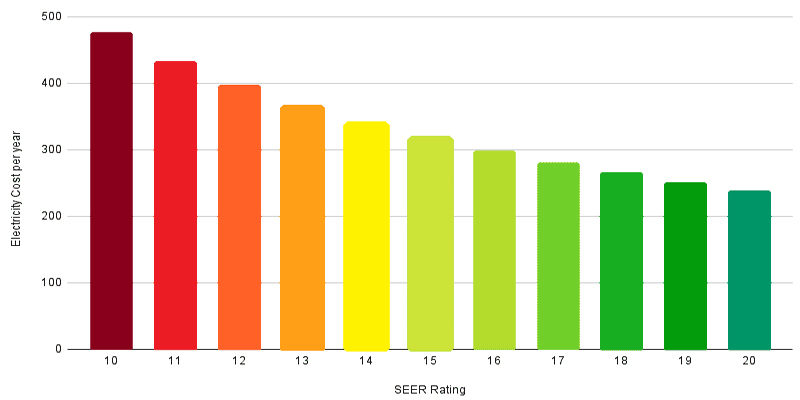
     

    SEER and electricity cost relations

    II. Is a higher SEER necessarily better?


    From the perspective of energy saving, it's true that higher SEER saves more electricity, but it depends on several factors:

    Advantages:

    Lower electricity cost

    High-SEER air conditioners will consume less electricity in long periods of operation, making them suitable for regions with high temperatures or long-term usage, such as the Middle East and Southeast Asia.


    More Eco-friendly

    Higher energy efficiency means less emission of carbon, which applies to the policies toward environmental friendliness and energy saving in European and American regions.


    Easier to pass export certification

    CE, GCC, ISO, and other certificates are all included with energy efficiency estimation. Air conditioners with higher SEER will be more likely to pass the tests and acquire the market access.

    Notes:

    High SEER ≠ the most energy-efficient in actual use

    SEER value is tested in standard working conditions, while the actual using environment, installation, and the indoor heat burden will all influence the energy-saving effect.


    Higher cost on the air conditioners

    High-efficiency air conditioners are normally adapted with a full DC inverter system, an excellent compressor, and a high-efficiency heat exchanger, combining to create a higher initial cost. It needs to weight the cycle of investment feedback based on the budget.


    High requirements for maintenance

    High-efficiency systems have high requirements for maintenance, cleaning, and installation, which are necessary to inspect regularly in the long-term use to maintain the working efficiency.


    III. How to select a cost-effective air conditioner with high SEER?


    Normal household users:

    We recommend choosing an air conditioner with a SEER between 15 and 18, considering initial cost and energy-saving performance.


    Commercial/long-term operation scenarios:

    Offices, canteens, and breeding farms can choose SEER 20+ air conditioners with low operation costs, which is considerable in long-term energy savings.


    Export enterprises/dealers:

    It is necessary to focus on the local compulsory requirements of energy efficiency if exporting to the Middle East and Europe markets, such as SASO, SEER >= 13, EU ERP standard, etc.

     

    Air conditioner adaption nowadays


    IV. SEER advantages of KRG air conditioning products


    • As a professional exporting brand in air conditioners, KRG provides a series of products from SEER13 to SEER25+, meeting different energy efficiency demands in various markets:
    • We support several international energy efficiency certifications, such as GCC, ISO, CE, CQC, ROHS, and ect.
    • We provide T1/T3 air conditioner solutions for high-temperature regions.
    • Our products apply to various scenarios: household, commercial building, farming, etc.
    • We can customize high-efficiency air conditioners that meet energy-saving project bidding requirements


    It is true that SEER is the key index to weigh the energy-saving performance of air conditioners. Whether the higher SEER product is much better, it needs a comprehensive evaluation based on actual demands, operation environment, and the budget. Only by choosing a proper and suitable SEER value can we achieve energy savings, environmental friendliness, and the maximization of long-term value in a real sense.

     

  • 5 Signs to Replace Your Old Air Conditioner

    An air conditioner is different from cellphones that can be replaced while broken. Most people think, "It can be used as it is still blowing air." In fact, old air conditioners not only consume more electricity and perform poorly in cooling effect but also influence our health. Check the 5 obvious signs below to see if you need to change to new air conditioners.


    1. Loud noise/Smelly smell


    Starts like a tractor? Air blowing with a strange smell and humid?

    These are signs of aging, going moldy, and the motors abrading inside of the air conditioner. Being exposed under such conditions would lead to health problems, such as headaches, throat discomfort, skin sensitivity, and respiratory illnesses. This should be a concern for households with kids and the elderly.


    2. Higher and higher electricity bill


    Same operation habit, but higher and higher costs every month?

    The old air conditioners have high power consumption and low efficiency, particularly the non-inverter model. It operates at full speed and obviously consumes more power.

    New inverter models could adjust the power consumption according to the ambient temperature, saving energy and keeping silent.


    3. Worse and worse in cooling (heating)


    Not working after turning it on for a while? Low airflow, slow cooling?

    This would result from the compressor aging, refrigerant leakage, the vent blocking, etc. If it doesn't work after times of fixing, then it shows the deep decrease of the performance; it's better to replace it with a brand-new air conditioning unit.


    4. Malfunctions occur frequently, and it's endless to fix all


    Not operating today, water leakage tomorrow, and loud noise the day after tomorrow.

    If the air conditioner had been repaired 3 times in a year, the charges could afford a new one; then there is no need to fix it. --"Out with the old and in with the new".


    5. Long period (10+ years)


    The lifespan of air conditioners is normally 8-12 years.

    If your AC has been used for 10 years or even longer, then its energy efficiency ratio, cooling effect, and durability are not as good as before, although it could still work.

    New inverter air conditioners have a 30% higher energy efficiency ratio; they are more energy-saving and cost-effective in the long run.


    Replace or not, it consumes health or wealth.

    If you have 2 or more similarities with the above, then do not hesitate now. It's time for you and your family to replace it with a more energy-saving, more silent, and healthier air conditioner.