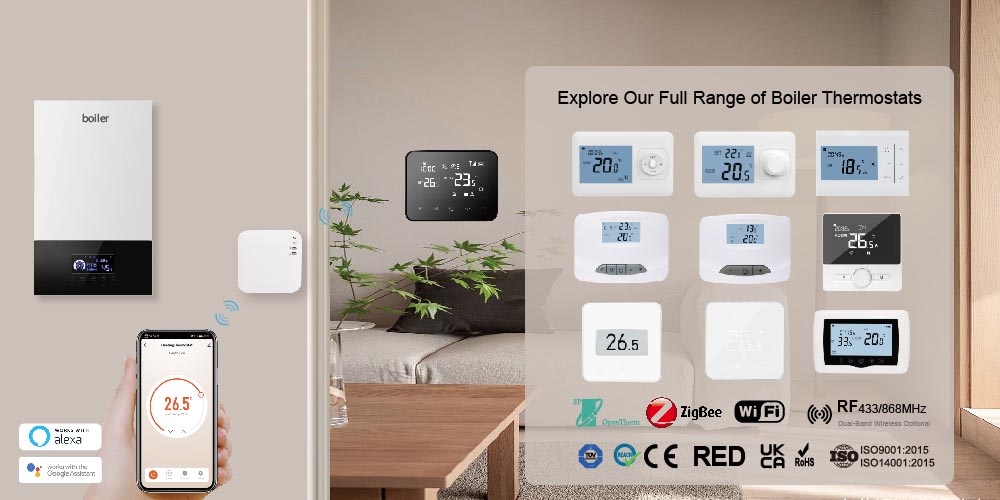
Minimizing Field Failures in European Wireless HVAC A 2026 OEM/ODM Engineering Guide
For Tier-1 European heating brands and cross-border HVAC wholesalers, the shift toward wireless control isn't just a trend—it's a high-stakes transition. While the residential retrofit market offers massive volume, it also introduces two of the biggest headaches in commercial HVAC: RF signal degradation in historic European architectures and the hidden costs of protocol non-compliance.
When a multi-zone residential project suffers from intermittent boiler firing, the blame rarely falls on the building's concrete walls; it falls on your brand's logo printed on the thermostat.
At E-TOP Controls, backed by 20+ years of dedicated HVAC manufacturing for the European market, we understand that an OEM/ODM partnership is not about buying hardware—it’s about outsourcing risk. Here is how we engineer reliability into our Wireless Boiler Thermostat Series to protect your brand's reputation and bottom line in 2026.
1. Physical Layer Reality: Why 868MHz Protocol Optimization Defeats "Smart" Wi-Fi on the Bench
Many consumer-grade IoT brands attempt to enter the European HVAC space using standard Wi-Fi or 433MHz architectures. In a laboratory, they work perfectly. In a 19th-century brick apartment building in Frankfurt or a multi-story stone house in Lyon, they fail.
-
The 2.4GHz Congestion Trap: Modern European households are saturated with Wi-Fi mesh networks, smart appliances, and Bluetooth devices. Deploying a Wi-Fi-dependent thermostat means your boiler control is competing with 4K video streaming for bandwidth.
-
The E-TOP Solution: We build our flagship wireless series on sub-GHz 868MHz RF technology, fully compliant with ETSI regulations. By implementing a proprietary frequency-hopping and narrow-band data transmission algorithm, our modules achieve superior wall penetration (30-50m+ through dense concrete) with a packet loss rate close to zero.
-
Battery Life vs. Polling Interval: A common field failure in cheap wireless thermostats is premature battery drain during winter. Our R&D team has optimized the firmware to use an ultra-low-power sleep/wake duty cycle. The thermostat only wakes up to transmit data when a temperature threshold ($\Delta T \ge 0.2^\circ\text{C}$) is crossed or during a mandatory heartbeat check, extending battery life beyond 24 months.
2. Advanced Modulation: OpenTherm Integration vs. Simple Dry-Contact Legacy Control
As Europe pushes aggressively toward Net-Zero building targets, simple On/Off (Dry Contact) control is no longer sufficient for premium OEM lineups. Modern condensing boilers from brands like Viessmann or Baxi require dynamic modulation to achieve their rated seasonal efficiency.
| Control Type | System Behavior | Energy Impact | Market Positioning |
| Standard On/Off | High thermal inertia, boiler short-cycling, increased component wear. | Baseline efficiency only. | Low-end / Budget Retrofit |
| E-TOP OpenTherm Modulation | Continuous, real-time flame adjustment based on PID error calculation. | 10% to 20% carbon reduction | Premium OEM / Tier-1 Fleet |
Our digital R&D lab has spent years pre-testing our OpenTherm communication stacks against mainstream European boiler protocols. This ensures that when you private-label an E-TOP thermostat, the derivative data—such as water temperature setpoints, fault codes, and modulation percentages—flows seamlessly between our controller and the boiler's mainboard without triggering generic system errors.
3. Supply Chain Integrity: APQP & FMEA Frameworks for Zero-Defect Manufacturing
For an automotive-grade or established HVAC giant, onboarding a new OEM supplier requires strict adherence to quality frameworks. A cheap component choice by a supplier can trigger a multi-million-euro product recall.
At our 8,000㎡ ISO 9001:2015 and ISO 14001:2015 certified production base, we treat quality as an engineering discipline, not a checkpoint:
-
Design FMEA (Failure Mode and Effects Analysis): Before a single PCB is printed, our 20+ engineer R&D team maps out potential failure points—from RF trace impedance mismatches to thermal drift on the NTC thermistor.
-
Advanced Product Quality Planning (APQP) & PPAP: We provide full Production Part Approval Process documentation to our large B2B clients, offering complete transparency into our component sourcing, SMT soldering precision, and automated optical inspection (AOI) yields.
-
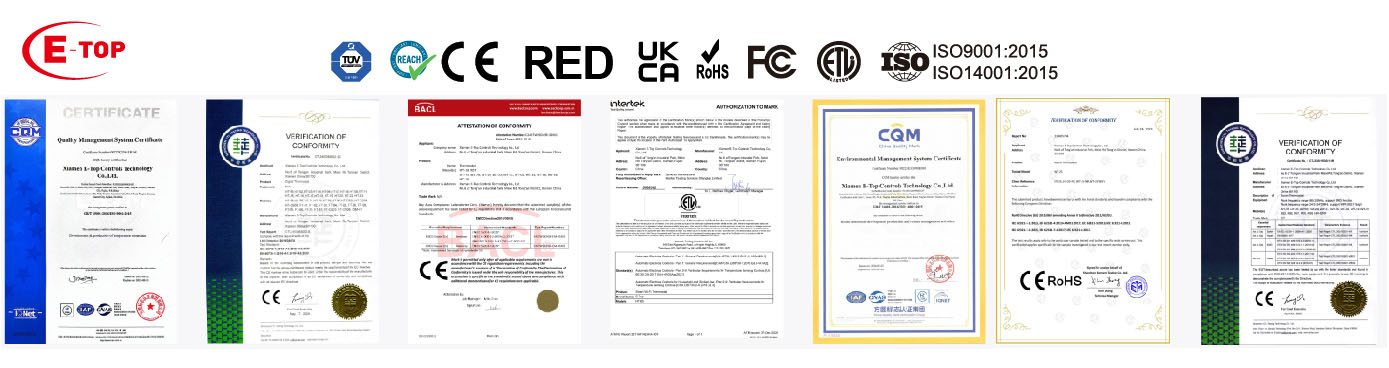
Strict Environmental Compliance: Operating in Europe means navigating a complex regulatory landscape. Every wireless device leaving our facility carries certified CE, RED, UKCA, RoHS, and REACH documentation, managed via an audited IQC/IPQC/FQC pipeline.
4. Multi-Zone Scalability: Engineering the Hybrid Wired/Wireless Ecosystem
Modern European HVAC systems are rarely simple. A single property might feature hydronic underfloor heating on the ground floor and wireless TRVs (Thermostatic Radiator Valves) upstairs, all tied back to a central heat pump or system boiler.
To solve this integration puzzle, we engineered our Multi-Zone Wireless Wiring Centres. Instead of contractors trying to daisy-chain individual relays on-site—which creates a nightmare for troubleshooting—our central wiring hubs act as the traffic controller. They seamlessly aggregate RF signals from multiple wireless thermostats, manage zone valve actuators, and handle the boiler delay logic automatically to prevent short-cycling.

Strategic OEM/ODM Cooperation: Moving Forward
If your current supplier is treating thermostats like simple plastic commodities, you are exposing your brand to field failures and compliance risks.
Whether you are looking to launch a private-label 868MHz wireless boiler thermostat for the upcoming heating season, or you need a custom-firmware solution compatible with specific commercial BACnet or Modbus systems, E-TOP Controls has the industrial infrastructure and 20 years of technical expertise to deliver.
-
Accelerated Prototyping: Turnaround on custom casing silk-screens, localized packaging design, and tailored firmware parameters.
-
Direct Engineering Contact: Skip the sales middleman. Work directly with our HVAC protocol specialists.
Evaluate our engineering capabilities firsthand. Contact our enterprise team today at info@etopcontrols.com to request a technical datasheet, a compliance report, or an engineering sample for your testing bench.
---------------------------------------------------------------------------------------------------------------------------------------------------------------------
FAQ for Procurement & Technical Directors
Q1: How does E-TOP guarantee RF reliability in highly insulated modern buildings?
A: Beyond utilizing the less crowded 868MHz band, our hardware includes automatic retry logic and optional signal repeater integration for large commercial layouts or deep-basement boiler rooms.
Q2: Can your wireless receivers handle dual-fuel or hybrid heat pump/boiler setups?
A: Yes. Our advanced receiver models feature dual-relay outputs and configurable firmware to manage auxiliary heat sources alongside primary heat pumps.
Q3: What is the standard lead time for a full OEM private-label production run?
A: For standard models with customized branding, packaging, and regulatory marking, our standard timeline ranges between 4–6 weeks, backed by a 95%+ on-time delivery rate.