Compliance Checklist for Importing Wireless Thermostats into Europe (CE, RED, RoHS & WEEE)
If your wireless thermostat doesn’t fully meet EU compliance requirements, you may run into problems at customs — including shipment delays, rejected goods, or even product recalls.
For HVAC distributors, wholesalers, and OEM buyers, skipping compliance is a massive gamble. A single missing certificate can completely block your products from entering the European market.
Here is exactly what you need to double-check before signing off on your next inventory order.
1. CE Marking: Required for EU Market Access
No CE mark, no European sales — it is as simple as that. The CE marking is mandatory for any electronic product entering the European Economic Area (EEA).
In reality, customs officers reject shipments every single day simply because of sloppy or mismatched CE documentation.
What to check:
- Is a fully updated EU Declaration of Conformity (DoC) readily available?
- Are the CE logos permanently printed on the device body, user manual, and outer box?
- Does your technical file reference the exact, current European directives?
2. RED Directive (2014/53/EU): For Wireless Thermostats
Any thermostat built with RF, WiFi, or smart communication must strictly adhere to the Radio Equipment Directive (RED). This is where many import issues happen — especially when RF modules are not fully tested.
In most EU projects, 868MHz is commonly used for wireless boiler thermostats and water underfloor heating controls because it tends to be more stable and less crowded than 433MHz.
RED also covers EMC and electrical safety, not just radio performance.
What to check:
- Is there a complete RED test report?
- Are the radio frequencies restricted to EU-approved bands (such as 868MHz or 2.4GHz)?
- Has the device undergone rigorous EMC (Electromagnetic Compatibility) testing?
3. RoHS Directive: Material Compliance
RoHS limits the use of hazardous substances such as lead, mercury, and cadmium in electronic products.
From an importer’s perspective, this is not just about environmental standards — non-compliant materials can cause issues during inspections or even lead to rejected shipments.
What to check:
- Is a RoHS compliance report available?
- Are PCB, components, and soldering materials compliant?
- Does the manufacturer follow lead-free production processes?
4. WEEE Directive: Recycling Responsibilities
WEEE focuses on how electronic products are collected and recycled at the end of their lifecycle. If you’re importing into the EU, you are usually responsible for local registration and recycling compliance.
In real projects, missing WEEE labeling or registration can delay market entry.
What to check:
- Is the crossed-out wheeled bin symbol shown on the product?
- Are you registered with the local WEEE authority (e.g., Germany’s EAR or the UK’s WEEE scheme)?
- Does your supplier support correct labeling?
Quick Summary: Documents You Should Request
Before confirming any order, most importers will ask suppliers for:
- CE Declaration of Conformity
- RED test reports (for wireless models)
- RoHS compliance reports
- WEEE labeling confirmation
If any of these are missing, it’s usually a red flag.
Work with a Compliance-Ready Supplier
At E-TOP, compliance is built into our product development process from the start.
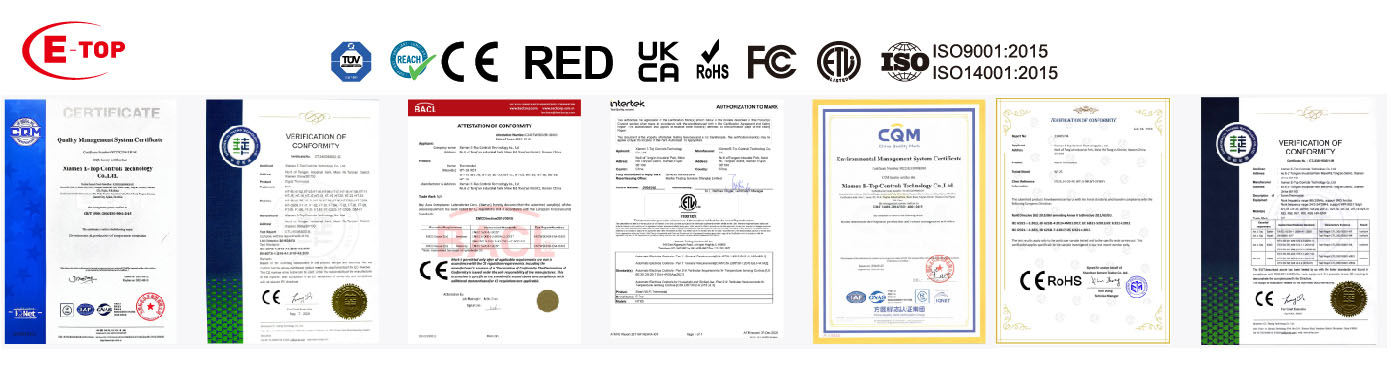
Our wireless and smart thermostats are tested according to EU requirements, and we provide complete documentation for importer verification. We’ve worked with customers across multiple European markets, and our products have passed compliance checks with documentation reviewed by accredited labs.
To learn more about our engineering capabilities, you can explore our full range of HVAC heating control solutions.
Need Compliance Documents for Your Project?
If you’re currently evaluating a wireless thermostat for the European market, we can shar
e our sample CE/RED reports and technical files for your engineering review.
Feel free to contact our team — we’re happy to support your compliance checks before you place an order.

---------------------------------------------------------------------------------------------------------------------------------------------------------------------
Frequently Asked Questions (FAQ)
Q1: Can I use a thermostat with a built-in pre-certified RF module without rewriting a full RED report?
A: This is a common pitfall. Even if the internal RF/WiFi module holds a valid RED certificate, you as the importer are still legally responsible for the compliance of the finished product. When the module is integrated into the thermostat, its radiation profile changes. Customs and EU market surveillance require a complete RED test report for the entire assembled device, not just the component inside.
Q2: Who is legally responsible for WEEE registration — the Chinese manufacturer or the EU importer?
A: Under EU law, the compliance responsibility for WEEE falls on the "first producer" inside the EU market, which is typically you, the importer. You must register with the local national authority (such as EAR in Germany) and display the crossed-out wheeled bin symbol on the product. However, as an OEM/ODM manufacturer, E-TOP ensures that the correct WEEE iconography is correctly molded and printed on the hardware from the factory, making your local compliance registration seamless.
Q3: Does the UK require CE marking, or do we need UKCA for heating controls?
A: While the UK originally planned to mandate the UKCA mark post-Brexit, the UK government has extended the recognition of the CE mark indefinitely for most goods, including electronic heating controls. Therefore, a fully compliant CE/RED thermostat can legally enter and be sold in both the EU and the UK market without requiring separate UKCA-specific laboratory re-testing.