Choosing the Right HVAC Thermostat Interface A Technical Selection Guide (2026)
When planning a commercial or residential HVAC installation, selecting the correct communication interface is the single most critical decision for long-term system stability. Whether you are building a robust network for industrial building management or retrofitting a smart home upgrade, the choice between RS485, 0-10V, or various wireless protocols will dictate your entire climate control efficiency.
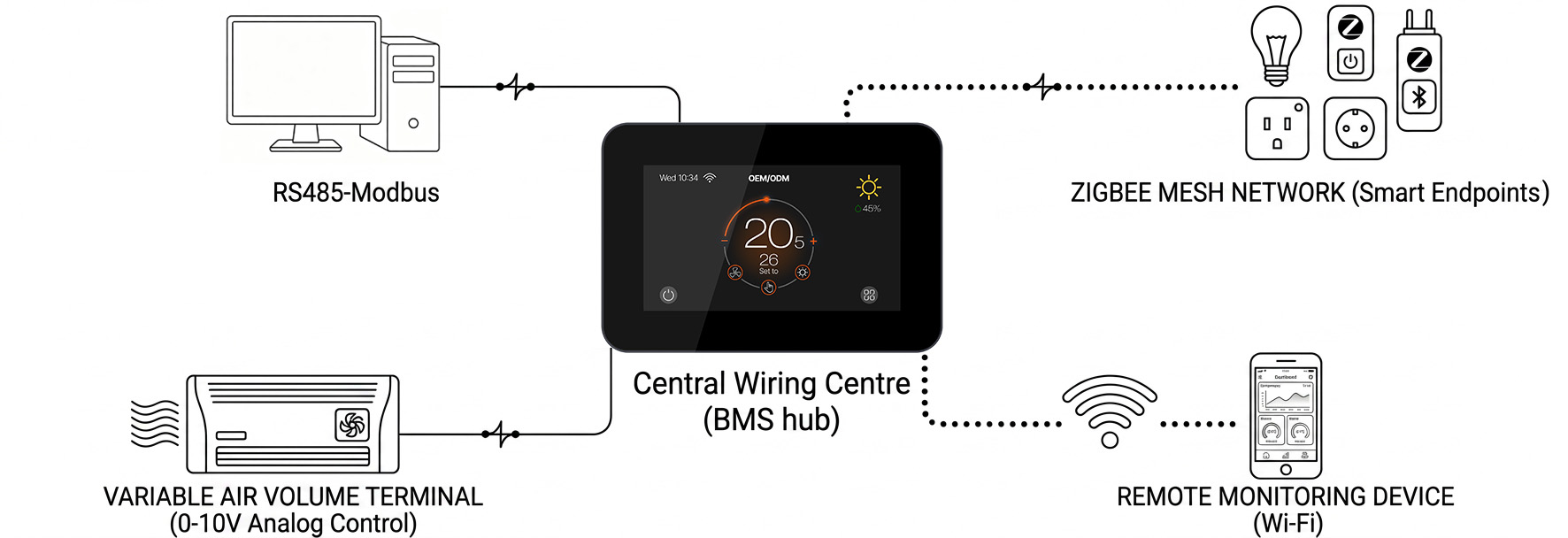
Comparison: How to Choose Your HVAC Thermostat
Based on our years of hands-on field installation experience, we’ve broken down the actual performance characteristics of mainstream HVAC control interfaces to simplify your selection process:
| Interface Type | Best For | Transmission Distance | Stability | Cost | Smart Integration |
| RS485 | Large-scale BMS | Up to 1200m | ★★★★★ | Medium | Good |
| 0-10V | FCU Modulating | Short-range | ★★★★ | Low | Basic |
| Zigbee | Smart Home Mesh | Medium (Mesh) | ★★★★ | Medium | Excellent |
| Wi-Fi | Residential | Router-dependent | ★★★ | Low | Best |
Engineering Insights: Which Should You Actually Choose?
Let's look at a real-world scenario. In our recent project for a large-scale commercial office, the system initially suffered from frequent signal dropouts because it relied on a Wi-Fi-based control system that couldn't handle the router congestion. The fix was simple but effective: we switched the architecture to a wired RS485 thermostat setup, which immediately achieved 99.9% uptime.
While wireless Zigbee thermostats offer fantastic flexibility for modern smart homes, our engineering team always recommends a hardwired RS485 backbone for any project that involves complex wiring or massive zone counts. However, if you are tackling a retrofit where breaking through finished walls isn't an option, a reliable wireless thermostat is going to be your best friend.

Deep Dive into HVAC Control Technologies
The Industrial Standard: RS485
For professional building automation, the RS485 thermostat remains the undisputed industry backbone. By utilizing the Modbus protocol, it allows for ultra-reliable, long-distance communication without any noticeable signal degradation. This makes it completely immune to the electrical interference often found in large, wired building management systems (BMS).
Precision Control: 0-10V Modulating Thermostat
When your project involves fan coil units (FCUs) or air handlers that require precise temperature regulation, a 0-10V thermostat is a must-have. Unlike traditional on/off switches that cause temperature swings, this modulating thermostat fine-tunes the output proportionally, ensuring optimal comfort and significant energy savings.
Modern Connectivity: Zigbee & Wireless Thermostat
In modern residential smart home environments, a wireless thermostat offers unmatched installation flexibility. Specifically, going with a Zigbee thermostat allows you to create a self-healing mesh network. This completely circumvents common Wi-Fi dropouts and ensures your smart thermostat network remains rock-solid even as the homeowner adds more devices to the system.
---------------------------------------------------------------------------------------------------------------------------------------------------------------------
Frequently Asked Questions (FAQ)
Q1: How do I know if I need an RS485 or a Wi-Fi thermostat for my project?
A: It mostly comes down to the scale of the building. Go with an RS485 thermostat for centralized building management systems where data reliability cannot be compromised. For residential projects that prioritize user-friendly app control and quick setup, a Wi-Fi or Zigbee smart thermostat is much better suited.
Q2: Can a 0-10V thermostat replace a standard mechanical thermostat?
A: Not right out of the box. A 0-10V thermostat or modulating thermostat requires a compatible actuator or FCU that can actually interpret variable voltage signals; always verify your HVAC equipment specifications before upgrading.
Q3: What is the main advantage of Zigbee over Wi-Fi for HVAC?
A: A Zigbee thermostat handles network traffic much better because it utilizes mesh networking, meaning each added device extends the overall signal range rather than crowding a central router. This provides a significantly more stable connection than standard Wi-Fi in larger residential installations.
Ready to Streamline Your HVAC Project?
With over 20 years of manufacturing experience, we specialize in providing tailored OEM/ODM solutions for global climate control needs. From heavy-duty, industrial-grade RS485 hardware to sleek, advanced Zigbee smart home ecosystems, we have the manufacturing expertise to support and scale your brand.
